by Jessica Doss
High School student at Little Rock Central High School (Little Rock, AK)
Honorable Mention
The satin-finish aluminum walls. The arching ceiling screen displaying sapphire-blue skies and an unusually yellow sun. Many humans can lay claim to being born-and-bred in the most exotic places on Earth, but can you top me? This spaceship is all I, Nila Emerson, have known, for my mother birthed me on this exact day, 16 years ago, 4,000 light-years away from Earth in Who-Knows-Where, The Milky Way. Besides from being the first (and only, at the moment) person to be conceived and created in outer space, I can’t say much else to brag about my life, especially now. Even if we’re just 2 years away from reaching ProtoHab1, Vestigo has been acting up a bit lately, with sudden slowing and a growing rumble from the main engine. Mom and Dad, both Aerospace Engineers, tell me that we may even have to put back reaching our destination for up to 7 years, if conditions worsen. Chemical Engineers, Biologists, and Physicists are all trying whatever they can to minimize fuel usage, optimize solar energy, and extend motor life.
Regardless, I think a tiny piece of us all fear for our lives and whether we’ll be forced to civilize inside a literal box. I mean, if that’s the case, overpopulation isn’t even an option. I start walking through Terminal C to get to the SimClass, where I take a seat in a lecture hall at UC Berkeley, the birthplace of this project. Looks like I’m early today, cause Professor Sanders walks to my desk and “sits” next to me. Soon after, without greeting, he prompts me with a question: “What do you want to do with this degree? Obviously, you’re studying aerospace engineering and computer science for a reason, right?
Your classmates all study this out of personal interest, and will most likely go on to work at scientific organizations and software firms here on Earth, but you, you are different. Nila, you happen to be one of the 501 people who are going to settle forever on ProtoHab1. Why do you want this degree, and how will it help you at your new home?”
I froze, dumbfounded by the immensity of this question. Truth given, I couldn’t even conjure a half- decent answer to tell the prof. Did I actually even want to study this? I knew it came in handy around the ship and might be helpful in circumstances like an abort mission or speeding the destination time, but for so long I haven’t been really learning much from his lectures, but simply committing things to memory. The application of such complex theorems and correcting perfect code seemed so distant, so improbable. What would a stupid 16-year old with not even a bachelor’s degree contribute to our small society?
“Nila? You got an answer for me?” asked the Professor.
“No sir….. I can’t even think of what I could do with it. I’m just sixteen!” I exclaimed.
“Well, don’t attend class today, and I want you to spend the day at the library. Sit down and think about the meaning of things you do. And just remember, being sixteen isn’t an excuse to not make a change. So many world leaders get started on their journey well before that. You’ve got a good mind and a good heart, Nila. Contemplate well and enjoy your birthday dear.”
Before I could answer, Professor Sanders disintegrates and the SimClass goes dark, leaving me stunned. Isn’t sixteen that age when you’re finally supposed to know how everything goes, life all set out like a table in front of you, with you able to choose the dishes you want and the dishes you don't? Well, I don’t think I’ve been more confused until today, with all those different foods melded together into one big question mark. Head down, I drag myself out to the library when out of the blue, the entire ship jolts forward , almost like it stopped abruptly. The lights and false ceiling start flickering, until the whole place goes dark asides from the small light that glows from our Wristphones. Petrified, I start running towards the control pit, where Mom and Dad would be. As I push through the panicky people, I hit walls, trip on objects, like God or whatever all-powerful being wants to stop me from getting there. Stumbling, I sit down in a small office to take a breath, only to realize that I ended up in a remote- location control room. Code streams across the screen, and I quickly identify the issue: A virus has breached the engine code. But how? The programs written for this ship took more than 25 years to perfect, and where could you even find an entryway to implant malicious code?
The more I examine the lines and lines of computations, it starts to make sense how such a simple Denial-of-Service bug could wiggle its way into the interface. People haven’t updated this program in 17 years, a year from the launch of Vestigo. This bug has been sitting here forever, doing all the damage it can to our systems, resulting in this crazy blackout and engine failure. Adrenaline surges within me as the heat builds from finding the problem, and my fingers rapidly start to fly across the keyboard, fixing line after line of code. It seems quite hilarious that even the basic tech support people couldn’t find such a small but vicious bug, but then the truth of the matter dawns on me: The elders on this ship haven’t learned anything new from their pHD in 18 YEARS! Sure we have books, and other resources, but how often do they use it, and it’s all outdated! In order to maintain cutting edge technology, we have to keep improving ourselves, heaving ourselves up an endless hill of knowledge. Also, being so removed from Earth, Earthly technology seems so far away and so primitive, even if it is way more advanced than this ship and we just seem to be oblivious to it.
I quickly finish fixing the bug, and run to main control at the front of the ship. As I approach the quickening rumble of the ship’s engine, Mom bombards me, hugging and kissing me like I died and came back to life. She exclaimed, “Honey, I thought you were hurt from all the rumbling! Some miracle, it was fixed quickly. I don’t know how the crew would manage being stranded here.”
I stood silent, feeling relieved, yet the fact that these superiors had no idea what they were dealing with kept nagging my conscience, squirming inside uncomfortably like a worm. Suddenly, I blurted out that I fixed the problem, and everyone here needs to be educated regularly, not just the youth. The passersby stopped to stare peculiarly, but my confidence was increasing. The engineer design process whizzes through my head, starting with the problem, which is the lack of modern education in the elder crew mates. I think about how doctors and teachers have to renew their license after certain periods of time, and must undergo professional development to maintain their skill set. Soon, I’m spitting out ideas about how every two years, all crew mates must attend 80 hours of job reinforcement training to help grow their skill set, with more relevance to modern-day tech. The words tumble out of my mouth, giving new instructions for the prototype curricula.
To my surprise, many listened, possible because I fixed the seemingly difficult bug in the engine. As I work towards this newly-surfaced problem with a fresh sense of respect from my crew, I realize that I have found my answer to Professor Sanders’ Question. My degree just saved the lives of 500 people, but going further, it has dawned that I want to be able to pass on the wealth of knowledge to the people who proceed me. Turns out, sixteen isn’t so little to make a difference after all.
Engineer's Note:
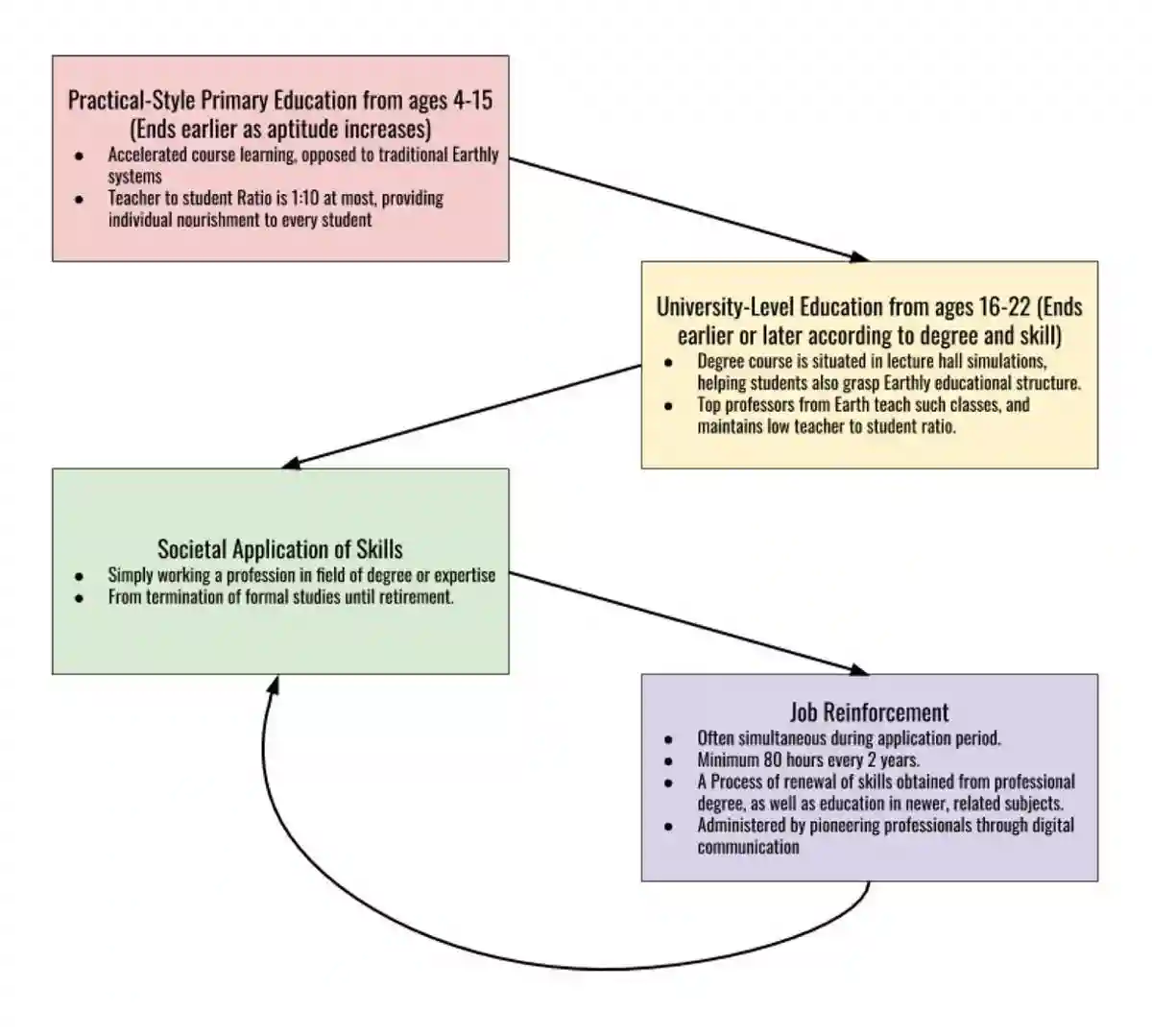
The education system designed within this scenario denotes a process in which adults on board the ship, and later on ProtoHab1, will have to renew their degrees similar to that of an occupational license of certain professions. This will involve such adults with degrees, terminal-level or not, to learn new skills and facts over a period of 80 hours of professional development/job reinforcement every two years. The training will take place upon the Vestigo, in which individuals will be paired with professors from our sponsor college, UC Berkeley. The classes will be solely online, conducted in the personal small screens given to all crew mates. Those under the age of 16, or currently enrolled in grade schooling, will be transitioned into a largely practical-learning based environment, opposed to traditional schooling methods. This aids in the proper processing of information, as well as helping long-term memory storage. Practical learning enables young children to learn skills as they would be used in real-life scenarios, and may accelerate them when obtaining a professional degree. Students will start University courses towards their degree at the age of 15, with accelerated pace benefiting the ProtoHab1 society as it develops. As the ProtoHab1 civilization grows with population, such digital forms of learning will slowly transition back into manual teach, while still retaining practical style teaching. New technology will be introduced on ProtoHab1 similar to the market trade system on Earth, also easing out the elders from a constant necessity of learning. This system solves a temporary long-term problem, spanning approximately a few hundred years, in sequence to develop a new high-order society of the human race.
Annotated Bibliography
Myers, J. D. (2015, December). The Milky Way. Retrieved January 30, 2020, from https://imagine.gsfc.nasa.gov/science/objects/milkyway1.html
Myers explains the specifics of the Milky Way Galaxy, its structural composition, and human observations made on the subject matter. Distance between Earth and multiple points in the galaxy, as well as relative estimates in star density are presented in this website. Sister galaxies and galaxy systems are introduced. This website is apt for people with no prior knowledge on the specifics of the Milky Way Galaxy.
Sanders, D. P., & McCutcheon, G. (1986). The Development of Practical Theories of Teaching. Journal of Curriculum and Supervision, 2, 50–67. Retrieved from https://eric.ed.gov/?id=EJ341169
This paper defines teaching inside a practical-approach setting. It describes the mental benefit of learning through this method. Current administrative practices are observed, defined, and explained. The development of practical practices in teaching is discussed. This article is helpful for readers who are curious about the benefits and systems of practical experience based teaching.
Wassenaar, T. M. (2002). Contagion on the Internet. Emerging Infectious, 8(3), 335–336. doi: 10.3201/eid0803.010286
Wassenaar defines multiple forms of internet contagion in this article. Details about digital viruses are disclosed. Modes of spread and evolutionary pathways are presented in this article. Forms of viruses, such as worms and trojan horses, are discussed. This article is beneficial to readers looking to increase general knowledge on digital viruses.
Wood, D. (2014, March 6). Space-Based Solar Power. Retrieved January 30, 2020, from https://www.energy.gov/articles/space-based-solar-power
This article discusses how space-based solar energy systems work. It also discusses current technologies and how they operate. Possible system failure and safety concerns are addressed in this website. Cost of such technologies is disclosed. This website is helpful for people wanting to learn about solar power technologies.