by Manya
7th Grade at Ralston Middle School
Third Place
The 6:30 am alarm went off. Pamela knew that she was starting a new skill- gardening! She had a whirlwind of thoughts when she first heard she would join. Will I be good at it? Will I mess up? That’s kind of cool since my other skill is cooking! In the end, she thought I got this! (That’s because her mom told her to think that).
As she started walking toward the garden, she was shocked to see a large steel wall blocking her way! Trying to ignore the mild panic attack, she headed to the library. She found a book about the layout of the Vestigo spaceship. She had found the reason for what happened, but everyone began coming out of their rooms. She found Jessie- her best friend- and rushed her into the library.
“Is this about joining gardening? Cuz it’s mandatory for people when they turn twelve! Honestly… it’s not that bad!” Jessie joked.
“It’s not that actually… kind of. I woke up early to look at the gardens but, there was a wall blocking it!”
“Why would that happen?” Jessie inquired.
“Look here!” Pamela pointed at a page from the book about the spaceship, “It says that a wall would if there was a detection of poisonous gas and it was an emergency lockdown!”
“Weird… WAIT!!! That’s where our food source is! Let’s check the cabinets!”
“There is no more left.” Pamela tried to stay calm. She began pacing back and forth across the kitchen. Her stomach began growling for breakfast. She opened another cupboard. Empty.
Another… Empty. Another... EMPTY!!!!!!!!!!!!!!!!!!! Another…
“Thank goodness!” Jessie cried. There seems to be enough to last us a good three months!
“That would be great except for the fact that we are only 14 years into the journey so… that’s no good!” Pamela hit the EMERGENCY MEETING button and all of the alarms went off. She was told that it sounded a lot like a fire alarm on Earth. However, she had never been on Earth. She was only twelve years old. Children born on the ship were held up to VERY high expectations since this was a big deal for the human race. This was the first trip any human would make outside of the solar system!
By the time they made it to the main room, everyone was already there.
“We have some… news,” Pamela started.
“We only have enough food to last six months. Any ideas?” Jessie sure didn’t like to beat around the bush.
“WHAT!?” Everyone shouted in unison.
“Yep. A poisonous gas has spread in the gardens and it’s blocked by a steel wall. Like a quarantine,” Jessie explained.
“To the library!” Pamela’s Mom shouted. It was followed by titters of approval. “Find every book that can help us!”
Fifteen minutes later, the table was full of books. Pamela’s mom smiled as she saw three books about teddy bears brought by five-year-old Suzie (the youngest one onboard the Vestigo). Most of the other books were about fast farming and aquaponics.
“What’s A..kwa...poooooo...nics?” asked Suzie.
“Good job sounding out!” Suzie’s mom applauded.
“It says here,” Pamela said picking up one of the books “‘that it is a system of aquaculture in which the waste produced by farmed fish or other aquatic animals supplies nutrients for plants grown hydroponically, which in turn purify the water.’”[1]
“Ooooooooooooooooh. What other ideas do we have?”
“Well, in the fast ways to farm book is vertical gardening is also a technique plus it’ll take up less floor space!”
“We need a solution that will get started very soon.”
“Hmm.. here it says aquaponics only needs to be exchanged every year.[2] For vertical gardening, it will need to be watered every day!”[3]
“Let’s have a vote!” Someone suggested. Everyone agreed and in 5 minutes the results came in. The winner was… aquaponics.
“Time to build!” Everyone was super enthusiastic.
“Everyone will split up into groups according to skill. Gardeners, pick some fresh fruits and vegetables from the cabinets and try to salvage as many seeds as possible. Waterworks engineers, please filter as much water as you can! Zoologists, find the best fish that will pair together. Construction engineers gather materials. GO!” Pamela usually took charge of such situations. She also liked how everyone listened to her.
Pamela watched as people brainstormed with each other, and put up sticky notes with ideas on a wall. After watching for a while, she started adding her own as well. At the end of the day, she helped sort out the notes to create a Venn diagram - plants that are suited for aquaponics in one circle, and fruits and vegetables available on the Vestigo on the other. At the intersection of the circles, there was an admirably long list that included beets, citrus, onions, radishes, and many others. [4]
Pamela helped her mom design the aquaponics system, calculating the volume of water and length of pipes it would need to grow enough food for everyone aboard the ship. After that, they cut up vegetables in a way so that they would grow underwater by directly inserting them. And for the fruits, they picked out the seeds and potted them - the plan was to let them grow roots until they firmly grasp the soil, then take the entire plant out of the pot and place it into a pot connected to the system with holes in it. This way, the plant could get nutrients from the fish.
When everybody met the next day, water engineers had several tubs full of water and had pipes and pumps assembled. The zoologists had put some catfish, tilapia, and bass in the water already.
“We chose these fish because they are good for beginner aquaponics. Have to warn you - one book said they could eat each other but another[5] said they’ll be fine![6]” one zoologist said.
“We probably want to play it safe,” another suggested. Everyone agreed. When the food source is on the line, you don’t want to be risky.
The first step for the building was to get the fish in a tank and the plants in the growing bed. The zoologists carefully placed the catfish in one tank. They put bass and tilapia in the other. Meanwhile, Pamela, Jessie, and the other gardeners transferred the potted fruits into the soil and the cut vegetables hovering over a separate container of water next to it. Next, water engineers connected pipes to the plant containers with fine mesh to prevent dirt from getting in the fish water. Then, they attached pipes to the fish and a pump bringing the fertilized water to the plants.[7]
In about a week, some plants started wilting. After researching, Pamela found out it was probably because the fish were not producing enough waste! Pamela suggested bigger tanks and adding some other fertilizers to the plants. She kept detailed notes, to help her measure progress and share her learnings with other people.
After four months, Vestigo had a healthy supply of vegetables and fruits that was already on its way to the passengers on the Vestigo. Everyone celebrated with a grand feast and congratulated each other on surviving the challenge.
Engineer's Note:
Day 1: I’m starting a journal today. Our gardens have been shut down due to a gas leak! We only have enough food for four months. We have six more years on Vestigo. After brainstorming, we decided to create an aquaponics system.
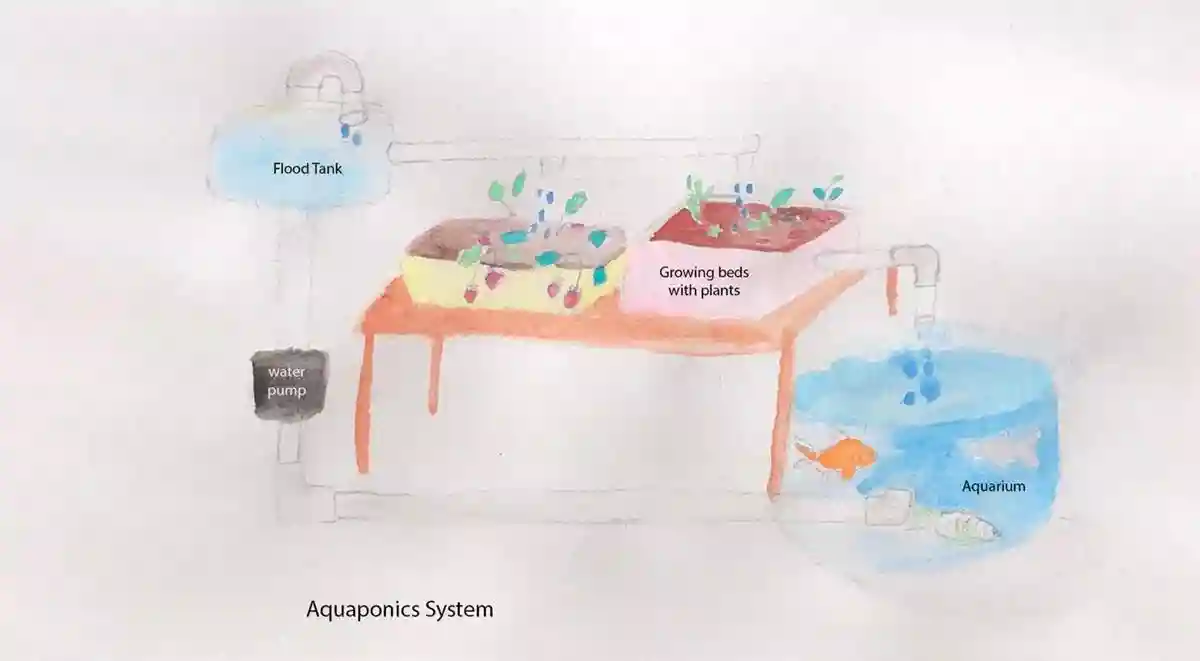
It works like this:
- Water from the aquarium is pumped up to the flood tank.
- Clean water is added to the flood tank.
- Flood tank irrigates plants.
- Plants purify water which goes to the aquarium.
- This repeats as a cycle.
Day 2: Everyone brought their assigned parts - plants, tubs, pumps, pipes, and fish! Waterwork engineers assembled the system.
Day 3: System is ready. The engineers are tired but hopeful. The plants are good and the fish aren’t eating each other.
Day 4: Found strawberry saplings in a garden laboratory. Suzie found potatoes that had sprouted eyes. Added them to the aquaponics system.
Day 7: Strawberry leaves look shriveled. Gardeners will keep watch
Day 8: I’m no expert, but the plants are definitely dying. Went to the library, found the plants need calcium.[8] [9] Luckily, an easy way is to give natural calcium from eggshells! [10]
Day 10: Jessie found a leak in the system. Water engineers fixed it.
Day 15: Engineers and zoologists got together and created Checklist for weekly inspection and Troubleshooting Guide with solutions to fix problems.
Day 30: Celery grew roots! Radishes almost ready! Started 5 more aquaponic systems.
Day 45: Had first crop of strawberries and radishes - delicious! Looking forward to more!
Annotated Bibliography
[1] This definition of aquaponics was provided from the Oxford dictionary.
https://www.google.com/search?q=what+is+aquapomics&rlz=1C1CHBF_enUS816US816&oq=what+is+aquapomics&aqs=chrome..69i57j0l7.3504j1j7&sourceid=chrome&ie=UTF-8
[2] This article Water Usage in Recirculating Aquaculture/ Aquaponics Systems, published in August 2009 is about the amount of water that is saved with aquaponics.
http://www.lanikaifarms.com/Recirculating%20Aquaculture%20Systems%20(RAS).pdf
[3] This source is from Times New York by Kristina Shevory and was published on May/10/2020. It gives an approximate amount of water needed for vertical gardening.
https://www.nytimes.com/2010/05/06/garden/06vertical.html
[4] Recommended Plants and Fish in Aquaponics by Nelson and Pade is a reliable source to find could fish and plants for aquaponics. They have raised all of these plants and fish in aquaponics themselves.
https://aquaponics.com/recommended-plants-and-fish-in-aquaponics/
[5] The article Keeping Tilapia in Aquariums describes tilapia ns aggressive. It also says how they will eat small fish.
https://www.tilapia.ws/aquariums.php
[6] In this article Tilapia by Southeastern Pond Management says that tilapia can be paired with bass.
http://sepond.com/fish-stocking/tilapia
[7] This is a video by NonHippieFarmer. It was published on February/ 3/ 2015. In this video, they give you a tour of their aquaponics system. And how they made it.
https://www.youtube.com/watch?v=A2YVPeMDq2I’
[8] 15 Most Common Problems With Aquaponics showed me that a lack of nutrients could become a problem in an aquaponics system. https://www.thegardeningpal.com/15-most-common-problems-withaquaponics/
[9] Calcium Deficiency by Wikipedipia informs on the signs of a calcium deficiency in plants.
https://en.wikipedia.org/wiki/Calcium_deficiency_(plant_disorder)
[10] This article shows a naturally easy way to provide plant calcium. The title is Using Eggshells in the Garden by Barbara Pleasant.
https://www.growveg.com/guides/using-eggshells-in-the-garden/